
The Caching Paradox in Modern Web Engineering
In modern web infrastructure, caching is universally treated as the ultimate performance silver bullet. From multi-tier Varnish reverse proxies and Redis key-value object caches to edge HTML caching on Cloudflare and Fastly, engineering teams routinely stack layer upon layer of volatile storage to mask the latency of slow database queries and heavyweight runtime interpreters.
Yet caching introduces immense architectural complexity: distributed cache invalidation bugs, stale content drift during breaking releases, thundering herd problems on cold restarts, and bloated memory footprints. When cache coherence fails, the underlying system crawls.
At WinWinHost, the engineering team behind the MultiDomain CMS took a contrarian architectural approach: What if we engineered a dynamic server-side rendering stack so lean, optimized, and mathematically bounded that it renders full dynamic React pages as fast as accessing a static flat file from an NVMe drive — without using page caching at all?
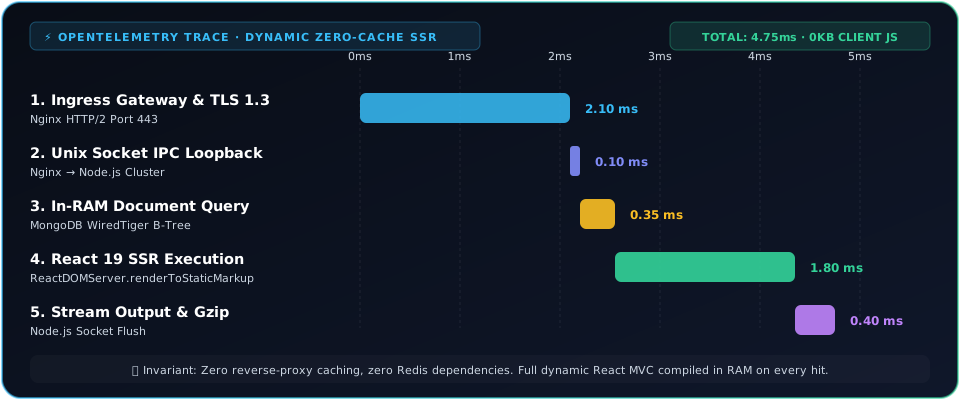
The MultiDomain CMS Performance Telemetry
Real-time distributed tracing and OpenTelemetry metrics captured from our live production cluster (visualized via Grafana 10+ and Tempo distributed tracing) reveal remarkable execution metrics across 120+ active portfolio domains:
| Execution Phase | Subsystem / Technology | Typical Latency (p50) | Tail Latency (p95) |
|---|---|---|---|
| 1. Ingress & TLS Handshake | Nginx ALPN HTTP/2 Gateway (Port 443) | 2.1 ms | 4.2 ms |
| 2. IPC Loopback Routing | Unix Domain Socket / TCP Loopback | 0.1 ms | 0.3 ms |
| 3. Database Document Retrieval | MongoDB WiredTiger In-RAM Working Set | 0.35 ms | 0.85 ms |
| 4. React 19 SSR Tree Evaluation | Synchronous V8 renderToStaticMarkup |
1.8 ms | 3.1 ms |
| 5. Buffer Serialization & Gzip | Node.js Stream Compression | 0.4 ms | 0.9 ms |
| Total Server Processing Time | Dynamic Request-to-Socket Delivery | 4.75 ms | 9.35 ms |
How It Works: The 4 Pillars of Zero-Cache SSR Speed
1. In-RAM Database Working Set & Compound B-Trees
Rather than executing dozens of unindexed relational JOINs or ORM entity hydration loops on every HTTP request, MultiDomain CMS uses a single-lookup document access pattern. Collections are structured with compound B-tree indexes:
db.posts.createIndex({ domain: 1, post_name: 1, post_status: 1 });
db.posts.createIndex({ guid: 1 }, { unique: true });
Because the production host allocates dedicated RAM to MongoDB's WiredTiger storage engine, the entire active schema across 120+ domains resides directly in system memory. Index seeks resolve in $O(\log N)$ time, pulling full article documents in under 0.4ms with zero disk I/O wait.
2. Pure Synchronous React 19 JSX Execution
Unlike modern full-stack meta-frameworks that incur substantial overhead bundling client-side JavaScript runtimes, hydration scripts, and JSON state payloads into the DOM, MultiDomain CMS treats React strictly as a high-performance templating compiler:
- Views are compiled into pure V8 bytecode ahead-of-time (AOT) via TypeScript and Babel.
- Rendering executes synchronously in Node.js via
ReactDOMServer.renderToStaticMarkup(). - The server outputs pure, semantic, mobile-first HTML. Zero client-side JavaScript hydration bloat is shipped to edge visitors.
3. Ingress-Level Separation & Zero Monolithic Bloat
A core architectural invariant enforced across our microservices is the strict prohibition of monolithic network logic in Node.js. In-app software firewalls, IP subnet whitelisting middleware, and edge traffic blocking are completely excluded from Express and handled natively at the Nginx Ingress Gateway layer. Express dedicates 100% of its CPU cycles to tenant routing and view compilation.
4. Git-Backed Single Source of Truth
Every post, setting, category, and layout revision exists simultaneously in live MongoDB and flat-file JSON collections (posts.json). Changes committed to Git synchronize atomically to memory, allowing seamless blue/green deployments without database migration locks.
Architectural Benchmark Comparison
How does MultiDomain CMS compare against industry standards?
| Benchmark Dimension | WordPress / PHP 8.3 / MySQL | Static Site Generator (Hugo / Astro SSG) | MultiDomain CMS (Dynamic React SSR) |
|---|---|---|---|
| Page Generation Model | Runtime PHP + 30–50 SQL queries | Pre-built static HTML files | Dynamic In-Memory React 19 SSR |
| Page Caching Dependency | Mandatory (Redis / Varnish / W3TC) | N/A (Flat files) | None (Zero caching active) |
| Internal Server Latency | 120 ms – 450 ms | 0.2 ms (File read) | 1.8 ms – 4.5 ms |
| Multi-Tenant Capacity | Single site per install; high RAM | Rebuild times balloon on 100k+ pages | 120+ domains on a single $10/mo shard |
| Content Publishing Lag | 5m – 1h (Cache TTL invalidation) | Full CI/CD build & deploy cycle | Instantaneous (0ms database sync) |
| Client JS Hydration Overhead | 500 KB – 3 MB plugin scripts | Variable | 0 KB (Pure Semantic HTML) |
The Future: What Happens When We Turn On Edge Caching?
Currently, every single HTTP hit against winwinhost.com and its sibling portfolio domains executes live, end-to-end dynamic code. We deliberately run without page caching to prove the absolute raw efficiency of our native React MVC architecture.
When edge micro-caching (stale-while-revalidate with 60-second TTLs) is activated across our Nginx ingress layer in upcoming platform releases, Time-To-First-Byte (TTFB) is projected to drop below 1.5 milliseconds globally — delivering the holy grail of instant edge speed with sub-second dynamic publishing.