
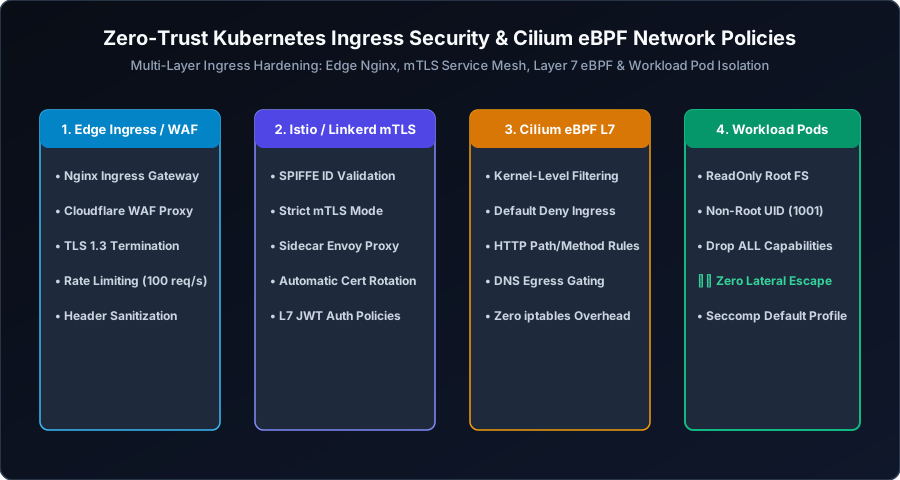
In modern cloud-native hosting environments, container perimeter defense is no longer sufficient. Once an attacker breaches a single public microservice, flat Kubernetes flat-network architectures allow unrestricted lateral movement. Implementing a true Zero-Trust Kubernetes Ingress Architecture requires combining hardened edge gateways with Cilium eBPF Layer 7 Network Policies and mutual TLS (mTLS) workload identity.
1. Layer 7 eBPF Filtering vs. Traditional iptables
Traditional Kubernetes network plugins (CNIs) rely on Linux iptables or IPVS to enforce traffic rules. In clusters with thousands of pods, evaluating tens of thousands of sequential iptables rules induces severe latency overhead. Cilium eBPF runs sandboxed byte-code directly inside the Linux kernel, enabling line-rate Layer 7 (HTTP/gRPC/Kafka) protocol inspection:
# CiliumNetworkPolicy: Strict L7 HTTP Ingress Rule
apiVersion: "cilium.io/v2"
kind: CiliumNetworkPolicy
metadata:
  name: "secure-api-ingress"
  namespace: "production"
spec:
  endpointSelector:
    matchLabels:
      app: backend-api
  ingress:
  - fromEndpoints:
    - matchLabels:
        app: nginx-ingress
    toPorts:
    - ports:
      - port: "8080"
        protocol: TCP
      rules:
        http:
        - method: "GET"
          path: "/api/v1/.*"
This policy strictly restricts incoming traffic to the backend-api pod so that only requests originating from the ingress controller and matching the designated HTTP path pattern are processed, blocking lateral connection attempts from compromised pods in other namespaces.
2. Workload Pod Hardening & Seccomp Profiles
To eliminate container breakout vectors, all application pods must run with immutable root filesystems and non-root user IDs:
# Pod Security Context Hardening
spec:
  securityContext:
    runAsNonRoot: true
    runAsUser: 10001
    runAsGroup: 10001
    fsGroup: 10001
    seccompProfile:
      type: RuntimeDefault
  containers:
  - name: app
    image: registry.winwinhost.com/app:1.2.0
    securityContext:
      allowPrivilegeEscalation: false
      readOnlyRootFilesystem: true
      capabilities:
        drop:
        - ALL
By enforcing readOnlyRootFilesystem: true, attackers cannot write malicious binaries or web shells to disk. Any temporary state must be mounted via ephemeral in-memory emptyDir volumes.
3. Mutual TLS (mTLS) & Workload Cryptographic Identity
Zero-trust architectures mandate that network location cannot confer trust. All east-west pod communication must be encrypted and cryptographically authenticated using SPIFFE/SPIRE identity standards or a service mesh like Istio or Cilium Service Mesh.
Each microservice receives an X.509 SVID (SPIFFE Verifiable Identity Document) containing its unique identity URI:
spiffe://cluster.local/ns/production/sa/payment-serviceSidecars automatically perform mutual TLS handshakes for every inter-service call, rotating cryptographic certificates every hour without service disruption. This ensures that even if traffic is sniffed on the underlying node, sensitive payloads remain fully encrypted.
4. Ingress Gateway Hardening & Edge WAF Policies
The Kubernetes Ingress controller serves as the front door to the cluster. Secure the edge using hardened Nginx Ingress annotations and OWASP Core Rule Set (CRS) inspection:
apiVersion: networking.k8s.io/v1
kind: Ingress
metadata:
  name: edge-ingress
  namespace: production
  annotations:
    nginx.ingress.kubernetes.io/ssl-redirect: "true"
    nginx.ingress.kubernetes.io/force-ssl-redirect: "true"
    nginx.ingress.kubernetes.io/ssl-protocols: "TLSv1.3 TLSv1.2"
    nginx.ingress.kubernetes.io/limit-rps: "20"
    nginx.ingress.kubernetes.io/limit-connections: "10"
    nginx.ingress.kubernetes.io/server-snippet: |
      more_clear_headers Server;
      add_header X-Frame-Options "DENY" always;
      add_header X-Content-Type-Options "nosniff" always;
spec:
  ingressClassName: nginx
  rules:
  - host: api.winwinhost.com
    http:
      paths:
      - path: /
        pathType: Prefix
        backend:
          service:
            name: backend-api
            port:
              number: 8080
5. Policy Enforcement via Kyverno Admission Controllers
Prevent non-compliant pods from ever reaching the cluster by deploying automated admission control with Kyverno. The following ClusterPolicy blocks pods that request root privileges or lack resource limits:
apiVersion: kyverno.io/v1
kind: ClusterPolicy
metadata:
  name: enforce-pod-hardening
spec:
  validationFailureAction: Enforce
  rules:
  - name: validate-non-root
    match:
      any:
      - resources:
          kinds:
          - Pod
    validate:
      message: "Pods must run as non-root with allowPrivilegeEscalation=false"
      pattern:
        spec:
          securityContext:
            runAsNonRoot: true
          containers:
          - securityContext:
              allowPrivilegeEscalation: false
6. Continuous Runtime Threat Detection with eBPF Falco
Even with preventive admission controls, runtime observability is necessary to detect zero-day exploits. Falco leverages the Linux kernel eBPF driver to monitor system calls and alert on anomalous activity:
# Sample Falco Alert Rule
- rule: Terminal Shell Spawned in Container
  desc: Detect interactive shell execution inside a production container
  condition: >
    spawned_process and container
    and proc.name in (bash, sh, zsh, dash)
    and not user_expected_terminal_shells
  output: >
    Spurious shell spawned in container (user=%user.name container_id=%container.id
    image=%container.image.repository command=%proc.cmdline)
  priority: WARNING
Frequently Asked Questions
Why is Cilium eBPF preferred over Calico iptables for large Kubernetes clusters?
Cilium compiles packet filtering programs directly into the Linux kernel using eBPF, achieving $O(1)$ constant-time lookup performance regardless of the number of pods or rules. In contrast, iptables uses linear sequential evaluation ($O(N)$), causing severe latency degradation when clusters scale past hundreds of services.
Does enabling mTLS across all microservices significantly degrade cluster latency?
Modern CPUs equipped with hardware AES-NI instructions can process TLS 1.3 encryption with negligible CPU overhead. In production benchmarks, mTLS adds less than 0.5 milliseconds to inter-pod requests while providing cryptographic mutual authentication and session secrecy.
How can teams roll out default-deny NetworkPolicies safely?
Begin by deploying policies in audit or monitoring mode using Cilium's Hubble observability UI. Hubble maps all active network flows across namespaces in real time, allowing engineers to generate explicit ingress and egress rules before switching policy enforcement from permissive to default-deny.
What is the difference between validating and mutating admission controllers?
Mutating admission controllers can modify pod manifests before they are persisted into etcd (e.g., automatically injecting sidecar proxies or security context defaults). Validating admission controllers inspect the finalized manifest and either accept or reject the API request, enforcing security compliance.
Summary & Cloud Native Security Baseline
Securing Kubernetes in production requires moving beyond perimeter defenses. By implementing Cilium eBPF Layer 7 NetworkPolicies, strictly enforced non-root pod security contexts, Kyverno admission gates, and Falco runtime threat telemetry, cloud operators establish a resilient zero-trust baseline for mission-critical microservices.
Managed Kubernetes Cloud Hosting
Deploy high-availability Kubernetes clusters with dedicated NVMe nodes, pre-configured Cilium eBPF networking, and private subnets on WinWinHost.
Explore Managed Kubernetes →